Showing posts with label Philip Seymor Hoffman. Show all posts

Sunday, November 11, 2012

LEFF'12 day one and two: "The Master", "Greetings" and "Amour"


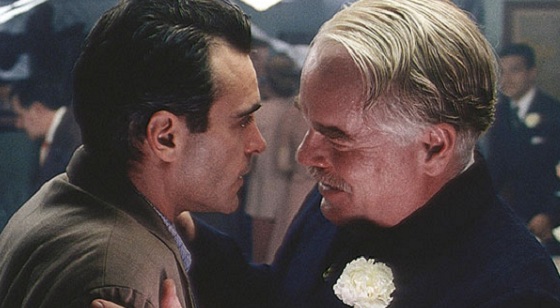
 I am not stretching my words to the length of a cat's tail writing about The Master (2012). I shall be back in a few months after I've seen it again and therefore be able to put into paper what I believe the experience deserves. I watched it last night as one of my most expected films of all time (considering I wasn't there for many of the great classics) and yet how could I still be surprised, I don't know. I am not speaking of quality evaluation. I am speaking of an unparalleled cinematic experience, much like Tree of Life (2011). Only I liked it more than Malick's, for being such an intensive character study. A tale of mentor-pupil, magnetically bonded like Baker Hall and John C. Reilley in Hard Eight (1995) (although, yes, the only thing I am currently questioning is Hoffman's motivation, because even Baker Hall has one). An hipnotic, time-traveling technicolor-like visual approach, carrying the rebirth of a man psychologically destroyed by the Second World War (Freddie Quell) at the hands of the founder of a religious cult (Lancaster Dodd), "The Cause", mystically hoping to cure the former soldier and thus believe he himself has unlocked the meaning of life. One is an hormonal wreckage, clinging to a bitter lost love (sweet innocence); the other, like Daniel Plainview, the most ambitious man in the world. Waving between Thomas Pynchon  in literature, and mixing Kubrick and Fellini's perverse worlds with even more twisted, degrading and neglected fears, wishes and imaginations. Joaquin Phoenix is otherworldly (many will consider it "overacting" and its legitimate), Hoffman is bizarre and Amy Adams is ravishingly manipulative. Dodd fights an afflictive battle to try to understand Quell's mind, as he progressively becomes the only capable man of questioning the master, accomplishing his own rebirth and going back for his pure ancient desires. Between madness and make-believe, from oniric humiliation to magic-realistic lush (the dream and the phone, the eyes turning black, the decadent lust, the color of the sea).


My first ticket for Brian DePalma's retrospective gave me entrance to his 1968 Greetings, which won him a Silver Berlin Bear. I went in completely unaware of what I was up to see, but I did expect a thrilling plot and restless tracking shots. Instead, this satirical piece on Vietnam War, about three young men trying to elude the U.S. army's recruiters, unfolded as a sewing of sketches linked by world, characters and their expectations, but never by the usual causal-effect logic. I didn't know Jonathan Warden nor Gerrit Graham but watched Robert de Niro playing his first major role. DePalma brought DeNiro back as the same character played here, Jon Rubin, in Hi Mom! (1970), an adaptation of one of the funniest chapters of this piece: Jon convinces a woman to behave intimately in front of a camera with its lens cut like a window (the reference is obvious, Rear Window (1954)), an experimental project that instantly turns in something else when she's finally nude. It has a wonderful payoff when he works out the same plot on a Vietnamese woman, in the middle of a war he doesn't want to fight. It's a very nouvelle-vaguian sketch out of a very nouvelle-vaguian aesthetics (and the intertextuality is extremely obvious, as the references to Blow Up (1966)). A portrait where everybody is paranoid or obsessed about something (JFK's assassination, finding a soulmate, having sex), caring about the war seems more stupid and meaningless than singing for no purpose at all.
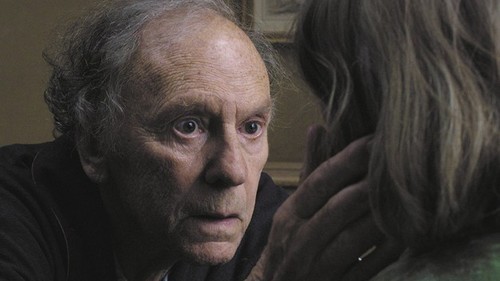


Amour (2012), by Michael Haneke, is not a perfume. It is a Golden Palm winner that stems out of a very truthful, very sad premise. It then breeds out of two brilliant performances by the European legends Jean-Louis Trintignant and Emmanuelle Riva. The colors are coherent, the texture and the framing create the lonesome house, a metaphor for minds of the characters, knowing their time is drawing near. Technically, nothing to point out and we even get the pleasure to hear a bit of music, not like many of his works. But it all goes away by minute twenty, when you've realized you still have two hours of endless boring chat, repetitive scene after repetitive scene, infinite shots where the old man cuts flowers one after the other. It's painful at some point. And not because of those people's suffering, which I don't deny but didn't care about. I would've liked it if it was a fifteen minute short film without dialog.

Friday, January 13, 2012

Moneyball (2011), just a taste

Just a taste because I'm planning to be back with Moneyball for a specific analysis to what I believe to be the brilliant work of powerhouse screenwriters Steve Zaillian & Aaron Sorkin. For now, let me stay with a general appreciation.

I seldom like sports movies. I find them particularly difficult to connect with, for sport breeds out of the immediacy of its single moments. The last hurdle, the last stroke, the last jump, the goal. The looming energy that powers collision between men and nature and between men themselves cannot be rehearsed and recorded sports events cannot fulfill us with the mystical satisfaction of physical conquering, if only a nostalgic flavor of it. Moneyball never tries to sell such moments as the ultimate arching goals of the story. Instead, it is driven by the backstage story of Billy Beaner while reforming baseball's management style as part of an unconscious life-examining quest. The main bases are the promising player he never became and the will and opportunity of never letting go an adorable twelve year old daughter. He is a logic cold-hearted business man as much of a temperamental intuitive heart-melted fan. He is the paradoxical faithful pragmatist and grabs Peter Brand to travel along into a journey much more about triumphing for their beliefs than storing loads of billions of dollars. We can connect with that. We take sports from the backstage all the time and during this film we're there with them. Actual footage transports us to an intermittent game precisely as Beaner deals with it. Exquisite sound editing bounces between his isolation and the cheering stadiums, as the green-yellow stripes and outfits wrap the space into a communion of a true team. I would be pleased to see Brad Pitt stepping to an Oscar and would consider the nomination for Jonah Hill and Seymour Hoffman. It is incredible the amount of masterfully held exposition we're thrown at without us even realizing it due to the sorkinesque snappy intelligent dialog, the depth of Beaner's character, the funny vein of some scenes and the wise camera and editing.

Friday, December 9, 2011

More developments on PTA's "The Master"


Paul Thomas Anderson has been gone now for as much as he had been between his glaring romantic dramedy Punch Drunk Love (2002) and the period oil epic There Will Be Blood (2007), two of the most remarkable masterpieces of modern cinema (and as far as my preferences go, of all time). By the end of 2009 he was set to start a new film, an alleged biopic of Scientology founder L. Ron Hubbard. Prior to shooting, things got off the tracks with the retreat from the investors and the dropout by Jeremy Renner, time when he may have started the now possibly finished script adaptation of a Thomas Pynchon's book, the 60's neon-lit neo-noir Inherent Vice.

Eight months ago, film lover Megan Ellison, daughter of the millionaire Larry Ellison, solved all our existential problems - some of mines, at least, and I do bet she couldn't take it anymore either - when she announced, alongside Annapurna Pictures the financial securing of both projects: The Master and Inherent Vice. Anderson decided to postpone his first incursion through film noir and rewrote the first one, from which Scientology would no longer be the backbone and leaving the fans querying themselves about a new title. The current promising synopsis goes something like this: Set in the 50's, a charismatic intellectual (Hoffman) launches a faith-based organization, creating a new religious belief system, and taps a young drifter (Phoenix) as his right-hand man. The drifter eventually finds himself drawn to the Master's daughter (Amy Adams) and distanced to the cause, questioning the nature what they've embraced and the authority of his mentor. An ambiguous promo-art poster came to public one month later, at the Cannes Film Festival'11, titled as Paul Thomas Anderson Untitled Project, announcing Philip Seymor Hoffman and Joaquin Phoenix as the main stars.

After the halts, by today we can surely assume "The Master" as one of the most expected films for 2012 (or 2013, let's hope not). The film was shot with a brilliant cast - the aforementioned; Amy Adams ("The Fighter"), Laura Dern ("Blue Velvet"), Kevin J. O'Connor ("There Will Be Blood"), Lena Endre ("Millenium" Swedish trilogy), David Warshofski ("There Will Be Blood"), Jesse Plemons ("Friday Night Lights"), Raimi Malek ("The Pacific") e Madisen Beaty ("The Curious Case of Benjamin Button") - and the screenplay has received huge appraisal from those who got their hands on the leaks. The soundtrack will be composed by the 2008 Oscar-robbed Johnny Greenwood, the guitarist from Radiohead, responsible for "There Will Be Blood" music. Good news kept coming as Amy revealed (to Collider) she takes part in one of PTA's beautiful virtuous long-shots and that working with him was "amazing" and as Emily Watson ("Punch-Drunk Love") stated (to Cigarettes & Wines) "I saw the first half an hour (...) It's incredible. I'm not going to say anything more on that. He'll kill me!".

The film is currently in post-production and now we can see some very intriguing backstage photos. My excitement was already settled when I suddenly read that Robert Downey Jr and Paul may actually be doing a film together, possibly "Inherent Vice", giving some factual basis to some long-run rumors.


Sunday, November 6, 2011

LEFFEST'11: The Ides of March (2011)

Although The Ides of March may have been sold, at some points, as the typical political drama starring George Clooney, foreseeing a much frayed genre melodramatic picture, you wouldn't have to dig too deep to find a glimpse of freshness. It all departed from the extraordinary poster, which portrayed with clearness the cynicism we would be invited to testify, but in a kind of witty and intelligent way. From there you'd peek at the rising star Ryan Gosling in a promising trailer performance and then at the old captains Philip Seymor Hoffman and Paul Giamatti in parts that could've fell by the hands of role-modeled actors like Clooney. Don't get me wrong, the acting director doesn't do a bad job. He is simply perfect for the character carved for him, and it's something we've seen him doing over and over, and not being great, he carries out well. On the other hand, Gosling draws a really great performance, the best I've watched him do (you will not forget the last shot from the film), backed up by the untouchables Seymor and Giamatti, who insistently make you want them to have more time up on the screen.

I think what makes me want to talk of the actors so much is the stylistic consistency I've tracked from Good Night and Good Luck to here. Yesterday I realized Clooney loves to work in approximate scales, namely the close up and the big close up. You're most of the times traveling on the dialogued contrivances of the plot while at the same time following a character-driven dimension of the film, from expression to expression, reaction to reaction. He does it in a pretty geometrical fashion, whether the shot is a rigorous 3/4 or a perfect profile picture, and just like he did in the film about Edward Murrow, he plays with the shadows on the faces to create a very nice suspense of what one may be thinking, feeling and hiding.

This being the first reason why I think the actors have such a particularly important figure here, now I'd like to add the well-written screenplay to the discussion. The Ides of March comprehends an intricate and in general well driven plot, which even ends up leaving you in the limb that divides the political drama and the political thriller. It opens with a very well paced twenty-minutes, with proper exposition, nicely economical, and finishes in a most fantastic third act. From the end of the first act until some point I'm not going to spoil you about, it may thank the cast for overcoming some common places and by making them yet enveloping. After this middle unexpected point (could've been much more melodramatic than it was), it is great to find that you're always wrong regarding what happens next, providing a successful way to handle the need to awake hypothesis in the mind of the audience. Although I believe in everything I've written so far, in the end I think what we will remember more intensely is not the plot or the twists, but the arch of Goslin's character, especially because of moments like the one in the kitchen, with Clooney's, when the writing (or the producing ?) surprises you by not making the latest the ultimate pretty adamant idealist politician, arising a good inner struggle in our protagonist (and avoiding an expected cliched development of Governor Morris). About the characters, I only have my doubts about the girl and her actions regarding her true situation - does it sound real, coherent ?

"I don't have a religion" and this is not the proper subtle film. Indeed, it works the desire to awake global consciousness, but I wouldn't call it moralist. It is very cynical that is, disenchanted, never letting the idealism by Morris win over the egoism of all the characters. All are good and bad, none is good nor bad. It sends you to the idea of unending circle (the arrival of the new girl) and of the weakness of mind of the engineers of the political campaigns and the political entrepreneurship of the United States, while the temporal track in which the film happens leaves you with the paradoxical assured incertainty of what had been going on till the movie began and what will be going on after it ends - a metaphor for what the worldwide citizens may feel about their society, for we're all assuredly uncertain that shit has been going on and will still be going on before and after we leave the room.

Saturday, April 16, 2011

Os próximos projectos de P.T.A. e Woody Allen

As atribulações que têm vindo a caracterizar o sucessor de "There Will Be Blood" são perfeito contraste da fluidez e do industrialismo dos trabalhos do nova-iorquino. Enquanto que Paul Thomas Anderson viu a Universal e Jeremy Renner abandonarem The Master, depois do processo ter estagnado devido ao seu "bloqueio criativo" (e, assim, por sua própria vontade), Woody Allen deu continuação à sua saga europeia, dando forma a "Midnight in Paris" (a estrear em Cannes'11), marcando o ritmo anual com que nos traz os seus filmes, sem quaisquer problemas de produção ou afins.

Mais tarde, e não há muito tempo, surgiram novas notícias em relação ao futuro de ambos. O primeiro estaria a começar a adaptar a mais recente obra literária de Thomas Pynchon, Inherent Vice, e Megan Ellison, filha do multimilionário Larry Ellison, anunciou estar pronta para garantir o financiamento do projecto, bem como o do adiado retrato do criador da cientologia. O segundo já teria mais uma encomenda "turística", Roma (já esteve, também, em Barcelona).

Pela data de hoje, tudo se confirma. Para Anderson, augura-se a dilatação das boas notícias até que vejamos as coisas na tela, já que surgiram vários nomes que podem completar o elenco de "The Master" - Joaquin Phoenix, Amanda Seyfried e Emma Stone. Em relação a "Inherent Vice", estarão em processo as conversações com Robert Downey Jr., para o papel de Don, um investigador privado, hippie, em plena LA dos anos 60. Para Allen, sem saber bem se é boa ou má esta ininterrupta corrente filmográfica, estão já garantidos Penélope Cruz, Alec Baldwin, Jesse Eisenberg e Ellen Page.

Como gigante fã de P.T.A., não será sequer possível ansiar mais por uma nova obra e estou certo de que todos os actores que se juntarem a qualquer dos seus projectos terão a perfeita consciência de que serão dirigidos pelo melhor (basta ver toda e cada interpretação que sacou aos actores, em todos os seus filmes). É também como grande admirador de Woody Allen que espero que volte com mais um grande guião (notando que os tempos de "Annie Hall" estão cada vez mais longe), embora ache que o senhor não sabe fazer maus filmes.